Factory of the Porsche Tycan, electric car, in Germany
In the early and mid-twentieth century, car manufacturing was both a major capital sink and the monopoly of a few large national capitals. Now any large and medium-sized national capital can mobilize the technology and capital to manufacture more and cheaper than the old European and American glories. Today an array of vehicles, [from Korean conventional cars to Vietnamese and Chinese electric cars] are coming to the European and US markets (https://www.spiegel.de/auto/auto-kaufen-wie-chinas-fahrzeugindustrie-auf-neue-kunden-in-europa-zielt-a-cdd48f6e-e343-48c1-9597-d2cdd31183ea). This is obviously bad news for the old industrial capitals, which need to secure a market or forcibly reinvent themselves to regain their differential position. With the support of the European states and the USA, the entire industry [is granted laws](https://www.motorpasion.com/industria/grupo-stellantis-tiene-claro-pide-que-coches-chinos-paguen-aranceles-para-entrar-europa) and [immense aid](https://www.elmundo.es/motor/2021/12/09/61b203c2fc6c83e01d8b45a3.html) that force the adoption of electric vehicles, i.e. the forced replacement of the entire fleet. All this not only provides a market in which to realize all the capital invested in battery and car technology, it also provides an opportunity to get ahead of the competition and monopolize all the intellectual property and techniques before they do. Not at the expense of national capital, obviously. But at the expense of the workers and the population in general, who provide the necessary margins for capital to make itself ever more profitable. Part of the big [conglomerates such as Stellantis](https://www.xataka.com/movilidad/stellantis-tiene-claro-que-precio-a-pagar-coche-electrico-cerrar-plantas-tambien-espana) are confident of this and are announcing it. [The electric car will be both more expensive](https://www.lemonde.fr/economie/article/2021/10/18/avec-le-basculement-vers-l-electrique-la-voiture-deviendra-un-bien-plus-rare-et-plus-cher_6098823_3234.html) and a [compulsory purchase](https://cincodias.elpais.com/cincodias/2022/10/27/companias/1666899011_381858.html) from 2030. Although measures will be taken to make combustion engines unusable in most cases before that date. No one need worry about the health of capital. Not only are electric cars nominally more expensive, but they require far fewer parts, plants and ancillary industry than the combustion car, which heralds [plant closures and mass layoffs of workers](https://www.xataka.com/movilidad/stellantis-tiene-claro-que-precio-a-pagar-coche-electrico-cerrar-plantas-tambien-espana). Significantly, the fact that it is easier to manufacture does not translate into higher production volume at lower prices with a larger number of plants, but rather the opposite. Naturally, the latter leads to the second move which is to try to drive any foreign competition out of the domestic market, as [Stellantis' CEO himself has been quick to call for](https://www.motorpasion.com/industria/grupo-stellantis-tiene-claro-pide-que-coches-chinos-paguen-aranceles-para-entrar-europa). Stellantis argues that the sharp rise in prices of cars that are theoretically simpler to manufacture is due to the high costs of obtaining and processing batteries and their materials. This is a bit puzzling, for two reasons: 1. Their Asian rivals seem to be able to make cars that are just as electric much cheaper, and 2. The main problem with battery materials is not their scarcity in their natural deposits, it is that there is no recycling process for the huge quantities of batteries that are effectively, but not necessarily, non-recyclable. ## Won't we have a cleaner environment? The metals in batteries are not like coal, they don't burn away, they don't have to be re-extracted when the battery breaks down. Battery recycling has been heralded as the [*big challenge of the electric car*](https://www.science.org/doi/10.1126/science.372.6544.780) but there is no rush to take this challenge seriously, in fact there is still no established standard for batteries to enable large-scale recycling. Everything points to the fact that the business will not be profitable for many years, among other things [thanks to the very strategy of making cars more expensive](https://www.businessgreen.com/feature/4056558/closing-uks-ev-battery-recycling-loop-net-zero-commodities-hub): > Hans Eric Melin, founder of specialist consultancy Circular Energy Storage, told BusinessGreen that there is "no chance" of a UK recycler relying solely on EV batteries before 2030, and predicted that the supply of used EV batteries would reach no more than 100,000 tonnes before the end of the decade. > > "I think it will be at least 10 years before we have a substantial volume of EV batteries," he said. "But what can be done, and what should be done, is to have more companies focusing on the used car side, because that's what's really going on: that's where the value is." A large proportion of used cars in the UK are shipped to third countries, which limits the number of batteries that end their useful life in the UK, he added. > > The cost-of-living crisis could further exacerbate the shortage of materials for scrap electric vehicle batteries, and he predicted that slowing car sales, due to shrinking household budgets, would eventually impact the recycling sector, as would current efforts by car companies to prioritize selling fewer, but more expensive, cars in response to the global shortage of semiconductors and rising raw material costs. > > Every million electric vehicles that go unsold will account for about 16,000 tons of cells that will not be available for reuse or recycling for a period of 10 years, he noted on Twitter. Indeed, unrestrained mining while selling used electric cars and spent batteries (traded in when down to 80% capacity, which is still an acceptable amount of margin) to poorer countries, is **a more profitable - and far more damaging - business than recycling batteries**. If states were to decide to *incentivize recycling*, it would be at the cost of more income transfers and state aid, not at the cost of capital's profits. But for now this does not seem a top priority issue for the ruling class, because the fact that China controls 60% to 80% of global lithium refining means that, once Chinese products are hit with tariffs and sanctions, the juicy business of lithium mining and refining will be open to big capital from the U.S. bloc. [Canada already opened the fray a couple of days ago by preventing the exploitation of lithium in its territory by 3 Chinese companies](https://www.reuters.com/markets/commodities/canada-orders-three-foreign-firms-divest-investments-critical-minerals-2022-11-02/). However, Stellantis - the US-French conglomerate - is not the only heavyweight in Europe. The German conglomerates and Renault-Nissan have different and conflicting priorities of their own. Where Stellantis is closing plants at home and trying to erect new tariff barriers, [BMW, Volkswagen and Mercedes are moving production to China](https://www.bloomberg.com/news/articles/2022-10-28/vw-mercedes-and-bmw-cross-their-fingers-as-china-risk-escalates). They are hardly compatible strategies, with some trying to get ahead of the trade war, while others are either directly hit - like Renault-Nissan hastily selling its plants in Russia at a loss - or put themselves in direct danger of receiving a mortal blow from the US-China trade war. Things are not looking too good for European capital.SK Hynix chip factory in China
The sector at the media center of the trade war is the semiconductor sector, and of all the hugely capitalized sectors it is one of those causing the greatest number of problems for the rest of the industrial chain. It is also the sector in which the difference between *advanced* and *mature* processes is most exaggerated. Let no one be fooled, the chip shortage is a convenient excuse to push the *CHIPS act* in the US and large investments in the semiconductor industry in other regions. Capital has very little interest in placing itself in the industry that makes the very chips that are in short supply in cars and aeronautics, the development of which has been left time and again to smaller companies and capitals. In fact, national capitals are vying to take control of the production of the ultra-advanced microprocessors and nodes monopolized by TSMC, SMIC and Intel. This is no surprise. For instance, economic analyses point out that the main cause of the US economic recovery in the 1990s was the boom in huge capital investments for the large-scale production of computers and semiconductors. These investments [far outweighed the supposed productivity improvements in the service sectors that were *digitized* during the same era](https://www.jstor.org/stable/2667350): > The late 1990s were exceptional compared to the growth experience of the U.S. economy over the last quarter century as a whole. Although growth rates have not yet returned to those of the golden age of the U.S. economy in the 1960s, the data nevertheless reveal a remarkable transformation. > > After twenty years of decline since the early 1970s, average labor productivity (ALP) grew 2.4% per year during 1995-98, more than a percent faster than during 1990-95. Total factor productivity (TFP) growth had been an anemic 0.34% per year between 1973 and 1995, but accelerated to 0.99% between 1995 and 1998. [...] Arguably, this represents a new paradigm. According to this view, the diffusion of information technologies improves business practices, engenders spillovers and increases productivity throughout the economy. > > In this regard, recent experience gives cause for caution, as much depends on productivity growth in high-tech industries. Continued technological advances in these industries have been a direct source of improved TFP growth, as well as an indirect source of faster capital deepening. Therefore, the sustainability of this growth is highly dependent on the future pace of technological progress in these industries. ## What makes next-generation chip manufacturing so attractive to capital? This part of the semiconductor industry is the focus of the trade war and state aid. Of all the branches of the industry, the large-scale (billions of units) manufacture of smartphone processors, graphics cards and SoC (*system on a chip*) chips with progressively more miniaturized nodes and details is where the most capital is safely placed and where it is easiest for a handful of companies to stay ahead. For instance, the ultraviolet lithography apparatus needed to **efficiently** make chips with tiny nodes is so complex and time-consuming to develop that it is virtually impossible for competitors to move to the front of the line. No matter how much money they bring to the table, the big companies will already be developing the next node by the time the new contenders reach the level of the previous node. These machines use super-detailed masks with the chip design in order to project UV rays onto the surface of the silicon disk to be *printed*. The fact that some parts of the surface have been illuminated and others have not determines the minute details of the chip's layer-by-layer construction, so the more the light beam can be *focused* at small scales, the smaller the details possible.... And the more exaggerated the technical problems will become. Among other things, light has to be efficiently emitted at smaller wavelengths, which requires laser systems that hit tiny tin targets at 10,000 cycles per second, convert them into plasma, and manage not to damage mirrors while generating sufficiently stable and strong light. This is not something that can be designed efficiently in 6 months, let alone manufactured. ## What does all this have to do with technological warfare and imperialist tensions in Asia? 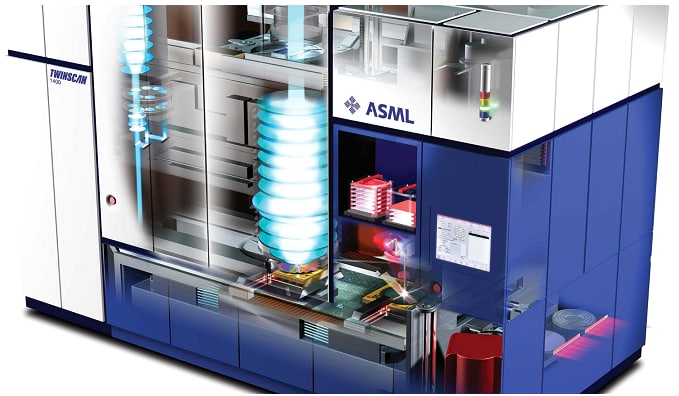Deep ultraviolet photolithography (DUV) ASML machine
Everything. The US is being so aggressive to **prevent these machines from being able to be used on Chinese soil**. This detail is very important, not only for Chinese companies, but for any company on Chinese soil. But **US does not manufacture the devices**, it is mainly Dutch and Japanese companies that are involved. The Dutch at ASML are the ones with the technological lead, which complicates the play. The U.S. way of putting pressure on the Dutch has been to prohibit the Dutch from selling machines with more than a certain percentage of U.S. components. But [the Netherlands has resisted banning exports](https://bits-chips.nl/artikel/there-wont-be-a-duv-export-ban-to-china-for-now/) and ASML has tried to avoid sanctions by partially redesigning its lithography machines and playing with definitions (what percentage of parts make a given component *US*). With the first round of restrictions, the US succeeded in blocking the most advanced machines, and a few days ago sent a second round of sanctions to block ASML's older machines, something [their Dutch allies ain't particularly eager about](https://www.bloomberg.com/news/articles/2022-10-21/asml-computer-chip-maker-tries-to-evade-us-china-tension#xj4y7vzkg). But the Chinese are far from the only ones affected by the second round of blockades, the RAM and flash memory plants of Korea's Samsung and SK Hynix are at risk. The Korean conglomerates have more than half of their production in plants on Chinese soil. SK Hynix has 50% of production at a single plant in Wuxi. The US has granted them a year without sanctions, but companies and analysts agree that this US blow is going to force them to [move production out of China and fall behind in global competition](https://m.theinvestor.co.kr/view.php?ud=20221019000055). However, things are not as finished for the Chinese as it might seem. [China's SMIC has announced that it can manufacture nodes at 7 nanometers](https://www.scmp.com/tech/big-tech/article/3190590/chinas-top-chip-maker-smic-achieves-7-nm-tech-breakthrough-par-intel), using technology suspiciously similar to that of Taiwan's TSMC (which has denounced industrial espionage). This is a very advanced node (it came out in 2018) that makes it possible to manufacture fast and powerful processors. The US move presupposes that the Chinese interest is identical to theirs, i.e. manufacturing at high volume for the global market, but this does not necessarily seem to be the Chinese goal with advanced nodes. It is true that the node at 7 nanometers can work without ASML machines, but it cannot do so efficiently. Many wafers will come out with defects, which is the real nightmare for large manufacturers. Pushing towards smaller and smaller nodes always results in a frankly large number of chips that don't work, forcing redundancies in design and throwing away or reclassifying products (a *9 cores* happens to be sold as a 7 when one or two fail, for example). This leads to cost overruns or prices that are not competitive in the world market for the capital invested. But these products are more than good enough to sell well in the huge and protected domestic Chinese market and that of its allies. And also more than good enough for Chinese military uses. In these respects, the U.S. attack is not very effective and in fact favors the development of local advanced technologies.... And indeed the Chinese are greatly expanding their semiconductor production capacity, but not just in the advanced nodes, but also in the mature ones. Which brings us to the next point. ## What about the rest of the semiconductor industry? 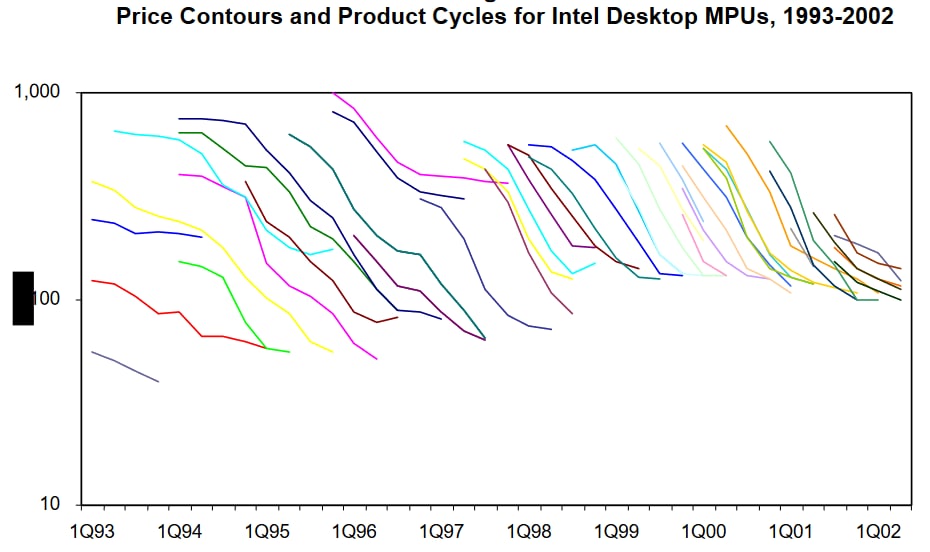
Chip price evolution
Outside the world of *leading-edge nodes*, the semiconductor industry lives at the opposite extreme. It is a world of dangerous investments, quick profits and bubbles that have knocked down the occasional national capital. Production depends on smaller capitals competing to maximize the profitability of production lines whose products, no matter how large the volume in which they are produced, drop in price by more than 30% for each passing year against a competitor with similar production technology. This was the strategy of Japanese national capital in the 1980s, during its industrial golden age. Industrial conglomerates joined together to form a mega-group that manufactured huge quantities of RAM much cheaper and in much greater volume than their US rivals. The rest is history. A US trade war and a brutal RAM price bubble completely destroyed the Japanese industry. To this day, there are no Japanese companies of note left in the high-end semiconductor sector. The Europeans also fell a few years later and the Koreans are the ones who took over the mass production of RAM memories. Samsung knows it lives dangerously, after all the *Hynix* of its competitor SK Hynix stands for *Hyundai Electronics*, a company that went bankrupt after the US attacked Micron and the Korean industry with an accusation of RAM price fixing. The company was ejected from the Hyundai conglomerate and moved to the SK conglomerate. Samsung is trying to veer into high-end logic chips at full speed, but the US is unlikely to let them do so easily. ## What does all this have to do with the lack of chips for car manufacturing? 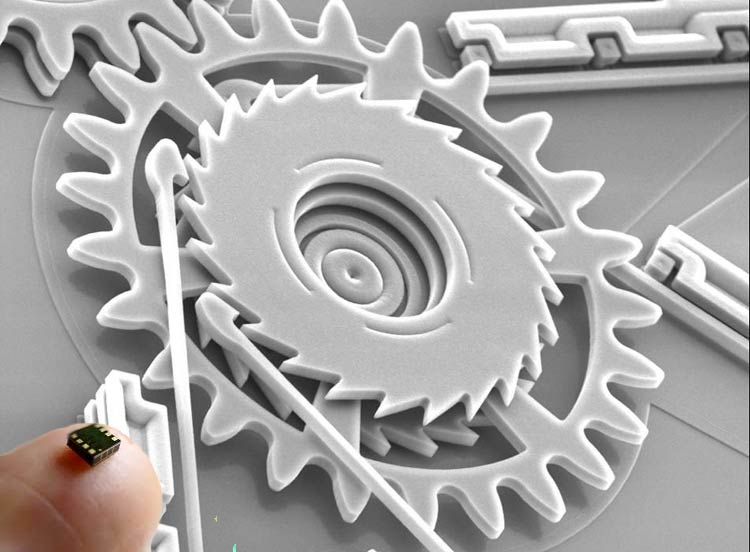A MEMS chip and an electron microscope detail of its mechanical parts
For large semiconductor companies with multi-type fab lines such as TSMC, microprocessor sales account for 81% of their revenues, while [automotive chips account for a meager 3-4%](https://investor.tsmc.com/english/encrypt/files/encrypt_file/reports/2022-01/f7c72d6d88b224476ab812fc3ba28169ec091a86/4Q21ManagementReport.pdf). The manufacture of components for vehicles and appliances is left to smaller companies, which must try to remain profitable while using outdated machinery and competing with dozens of companies at the same level. The distinction between advanced and mature nodes (and even *trailing edge*) is much more than a convenient label, their machinery and processes are completely different. Coordinated operations between large companies to raise wafer diameters and increase the number of chips per wafer only occur for advanced nodes. It is the advanced microprocessor and RAM manufacturers that use the big 300mm wafers, the vehicle chip manufacturers can't afford to change diameter and still mostly use 200mm wafers. The problem is that [no one is interested in continuing to invest in producing machinery and equipment for this diameter](https://www.fabricatedknowledge.com/p/earnings-roundup-2112022): > There is no way to increase the 200-millimeter volume. The equipment is no longer available and the older facilities, which have been mothballed, are obsolete. So increasing the volume is not possible. > > The *trailing edge* looks like it will be most affected by price increases, especially the 150 mm and 200 mm wafers. Price increases are likely to continue as long as there are critically important and specialized products that are unlikely to be replaced. Think automotive and other analog products. In the meantime, 200 mm wafers will never see an increase in capacity. These chips are of various types, from power electronics (which serve to regulate electric motors and voltage/power rather than logic circuits) to microelectromechanical chips (MEMS). MEMS are small engineering gems that miniaturize the detection of mechanical effects and couple them to electronic signals; they are what make airbags, ABS and aircraft guidance systems work. The problem for capital is that **their production is not as easy to scale-up** as is that of microprocessors. Putting more capital into larger factories does not generate competitive advantages. One of the reasons is the friction of the components on the one hand and on the other hand the viscosity of the fluids, which do not behave in a linear and simple way with respect to the size of the MEMS chips. While [power consumption of transistors niceely went down as more of them were packed into a smaller area](https://semiengineering.com/knowledge_centers/standards-laws/laws/dennards-law/). This, combined with the fact that MEMS features parts that are much more complicated to standardize, makes it much more complicated to miniaturize in order to increase the volume produced. In other words, and **regardless of how useful they are, capital always prefers large-scale logic circuit production**. Automotive chips are not profitable enough, and nobody is interested in investing in them, which is reflected in the actions - not the words - of large national capitals. After insisting on the seriousness of the shortage of automotive components and talking about the importance of *independence* in terms of components, the USA and Europe invest almost nothing in the production of automotive chips. It is China which is investing in their production, much more than the rest together, among other things because it acquired a large part of all the [world machinery at 200mm as of 2010](https://www.eenewseurope.com/en/china-drives-200mm-wafer-capacity-boom/): > Power semiconductor and automotive fab capacity will grow at a rate of 58% between 2021 and 2025, followed by MEMS at 21%, foundry at 20%, and analog at 14%. This is very different from the 300 mm wafer fabs used for state-of-the-art CMOS chips. > > China dominates production with a 66% increase by 2025, followed by Southeast Asia at 35%, the Americas at 11%, Europe and the Middle East at 8%, and Korea at 2%. By 2022, China is expected to have 21% of global 200mm manufacturing capacity, followed by Taiwan and Japan with 11% and 10%, respectively. ## What about the other major industries posting profits such as petrochemicals? 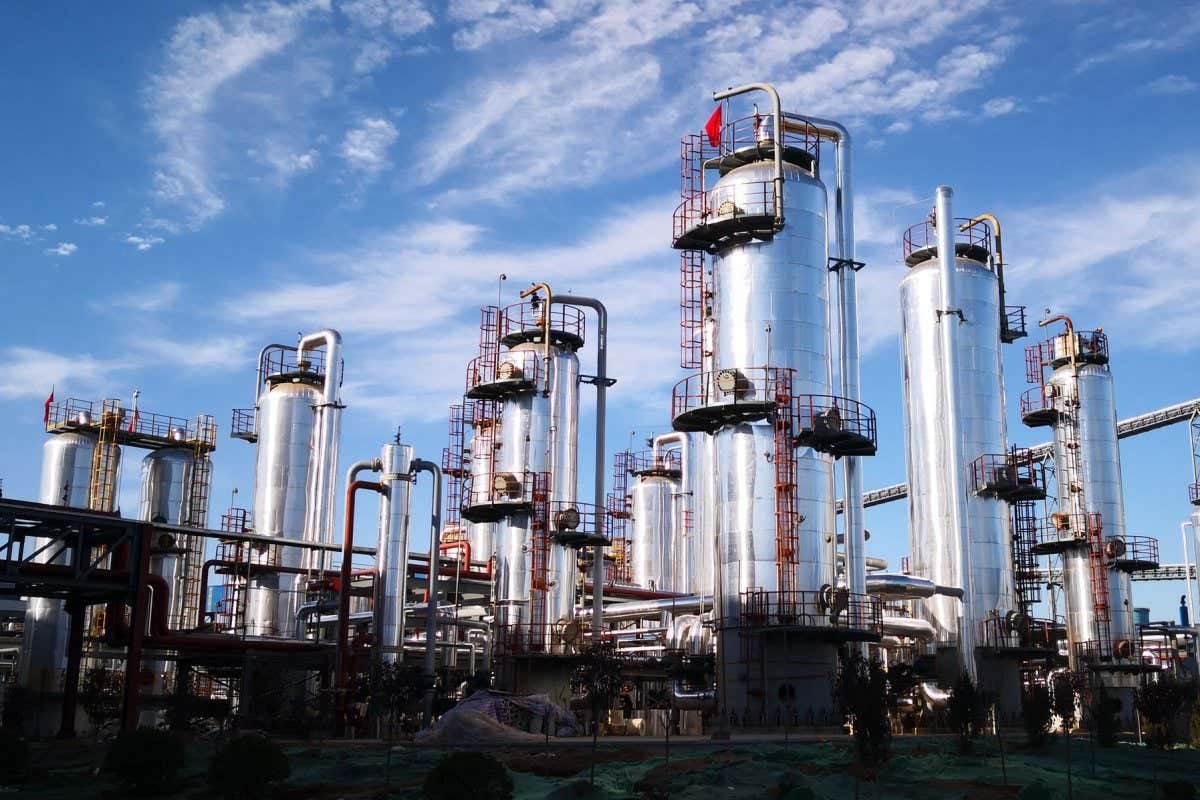 In a similar way to the automobile industry, the petrochemicals were to be converted through a combination of Green Deal income transfer and technology hoarding. But it is particularly complicated in their case. An example: the refinery recently closed by the U.S. government in the Virgin Islands where [*it was raining oil* and the plant threatened to explode at any moment](https://www.washingtonpost.com/climate-environment/2022/10/28/refinery-st-croix-epa-limetree/). This is a direct consequence of the need for huge scales and the need to gather large volumes of energy-dense chemicals on the same site. For now, the industry manages to [attract some investments under the guise of creating CO2 capture plants](https://www.france24.com/en/environment/20221104-co2-capture-and-storage-environmental-lifeline-or-blank-cheque-for-polluters), but they are not enough. The extremely outdated refinery processes can be replaced by more efficient and cleaner processes. After all, temperature separation processes such as distillation consume an enormous amount of energy at the industrial level and [are replaceable by advanced membranes](https://www.pnas.org/doi/10.1073/pnas.2022194118). But they are not cost-effective on the enormous scale needed to make the capital investment profitable. Even if the two processes were combined, the interest on the part of capital would be reduced. That is why the chemical industry will protect its huge plants as brutally as it can. For example, when Covid left a good part of the hospitals in Mexico without oxygen, the latter installed small pressure exchange-operated air separation plants. The big oxygen producers, who monopolize the production of liquefied air from huge distillation towers, immediately [legally harassed hospitals for building small plants](https://www.theguardian.com/global-development/2021/aug/25/oxygen-firms-accused-of-intimidating-mexican-hospitals-during-pandemic). Monopoly has to be maintained *no matter what*. Accumulation is not to be messed with. Lacking the ability to really change their processes for now, the petrochemical companies of the strongest national capitals have opted for other strategies to increase their attractiveness. While a good part of the refineries in the countries with the weakest capitals have closed or are at a minimum due to the energy chaos caused by the war in Ukraine and the sanctions against Russian hydrocarbons, the American and European oil companies are making huge profits with the very high fuel prices.Unions of the Navantia shipyards in Cádiz asking the state to get customers for the company
Since the eighties, the [unions](https://diccionario.marxismo.school/Sindicato) have been trying to make us swallow layoffs and *wage containment* by telling us that "we cannot ask from the company what it cannot give" and by hammering home the idea that "the welfare of the workers depends on the results of the company". It is quite clear that this was never true when companies were making losses and laying off workers, but it is even less true when companies are increasing their profits and... they lay off just the same. Capitalism does not work as the unions pretend: neither the big companies run accounts as if they were small businesses in order to lay off and hire, nor the national capital, coordinated and directed by the state, sticks to the exploitation accounts to decide its strategies. But the unions in all these sectors, from Korea to the USA passing through Algeria and Egypt, France and Great Britain, feign insanity and continue trying to impose *social peace*, organizing [meaningless testimonial marches](https://www.lemonde.fr/politique/article/2022/10/19/une-journee-de-mobilisation-en-demi-teinte-pour-le-pouvoir-d-achat-il-faut-que-ca-bouge-on-sent-que-c-est-assez-explosif_6146387_823448.html), [openly sabotaging](https://www.liberation.fr/economie/social/crise-des-carburants-en-seine-maritime-la-guerre-des-nerfs-pour-les-grevistes-20221013_V6GEAF4LNNDEPMCMGLGLSO6NZM/) the pressure capacity of those which they themselves summon into a strike and [doing their best to deflate the *real* strikes, that is to say those self-organized without their tutelage, which they call *wildcat* ones](https://marxismo.school/communia/es/huelgas-salvajes-2022). Y es que el cuento de hadas sobre cómo funciona el sistema de la *perspectiva sindical* no era un *error inocente*. Antes y ahora tratan de evitar el tipo de lucha que realmente tiene posibilidades de obtener resultados y mantener las huelgas en [el terreno que les da sentido](https://diccionario.marxismo.school/Sindicato) como organizaciones mediadoras del salario en el [capitalismo de estado](https://diccionario.marxismo.school/Capitalismo%20de%20estado). Si en los cierres por pérdida de la rentabilidad sólo cabe esperar de los sindicatos que organicen procesiones fúnebres y que se comporten como un grupo inversor más, en los cierres en los sectores hipercapitalizados que vemos ahora -como el automóvil o las petroquímicas- sólo cabe esperar de ellos un teatro para conducirnos a la pasividad. Se deben al capital nacional y el estado del que son parte y es su futuro el que les preocupa. No, the unions will do no real thing to stop these layoffs, because what we are seeing today is how the strategic sectors of national capital are reorganizing themselves to attract more capital and improve their own situation in the global [accumulation](https://diccionario.marxismo.school/Acumulaci%C3%B3n%20de%20capital). The important thing to point out is that they do so at the cost of worsening the general situation of the industrial apparatus, reducing productive capacities and leaving hundreds of thousands of workers in the street all over the world. Moreover, as we have seen, the movement is not limited to closures and layoffs in certain sectors, but also involves aggressive strategies of commercial and technological warfare. Movements that are just one step away from a blockade and fuel warlike tensions. A horizon in which in the end the workers have no other possible role than that of cannon fodder in a massive butchery. In Ukraine and Russia we can see a foretaste. This is no small thing. Capitalist growth - accumulation - has long been not only contrary to human development, it is increasingly incompatible with human life itself. This is seen in all its expressions: from health and food to technological development and art.